
Can Demucs, MVSep, BS-RoFormer, or MDX23c Be Used Commercially? Understanding MUSDB18, Model Weights, and Licensing

By Fabian-Robert Stöter, Head of Research at AudioShake and co-creator of MUSDB18.
Overview: Open-source music separation projects, including Demucs, MVSep, MDX23c and BS-RoFormer, have made powerful audio technology widely accessible. But some pretrained models were trained partly on MUSDB18-HQ, a dataset restricted to educational and noncommercial uses. The distinction between licensing code and licensing trained model weights matters. An open-source license may permit commercial use of the software without resolving the rights associated with its pretrained weights.
What MUSDB18 was built for (and what it wasn’t)
In 2017, I helped create a dataset called MUSDB18, alongside Zafar Rafii, Antoine Liutkus, Stylianos Ioannis Mimilakis and Rachel Bittner. It contained 150 full-length songs, about ten hours of music, each split into vocals, drums, bass and “other.”
The goal was simple. Researchers needed a shared benchmark so that when two labs claimed to have the better separation model, they were measuring the same thing. MUSDB18 became that benchmark. Almost every music source separation paper of the past eight years reports results on it, and the field moved faster because of it.
From the start, it came with a clear condition: the tracks can only be used for academic purposes. Most of the music was contributed under licenses that forbid commercial use. Forty-six tracks come from MedleyDB under CC BY-NC-SA 4.0. Others come from multitrack libraries and remix competitions with their own non-commercial terms. The dataset terms explicitly say that the dataset “is provided for educational purposes only and the material contained in them should not be used for any commercial purpose without the express permission of the copyright holders.”
Where things have drifted
Demucs is an open-source separation model released by Meta’s research team. It’s good work, and it has become the default “free” option for stem separation. Today it sits inside a long list of apps, plugins, DAWs and hosted services, many of them commercial.
Its most widely used version, HT Demucs, was trained on MUSDB18-HQ plus an additional 800 songs from an additional internal dataset whose licensing and provenance are not publicly documented in the Demucs paper. Demucs’s source code was released under the permissive MIT license. Its pretrained models, however, were trained partly on MUSDB18-HQ, whose recordings carry non-commercial restrictions. A permissive software license does not, by itself, establish that all rights associated with the training data or pretrained weights have been cleared for commercial use.
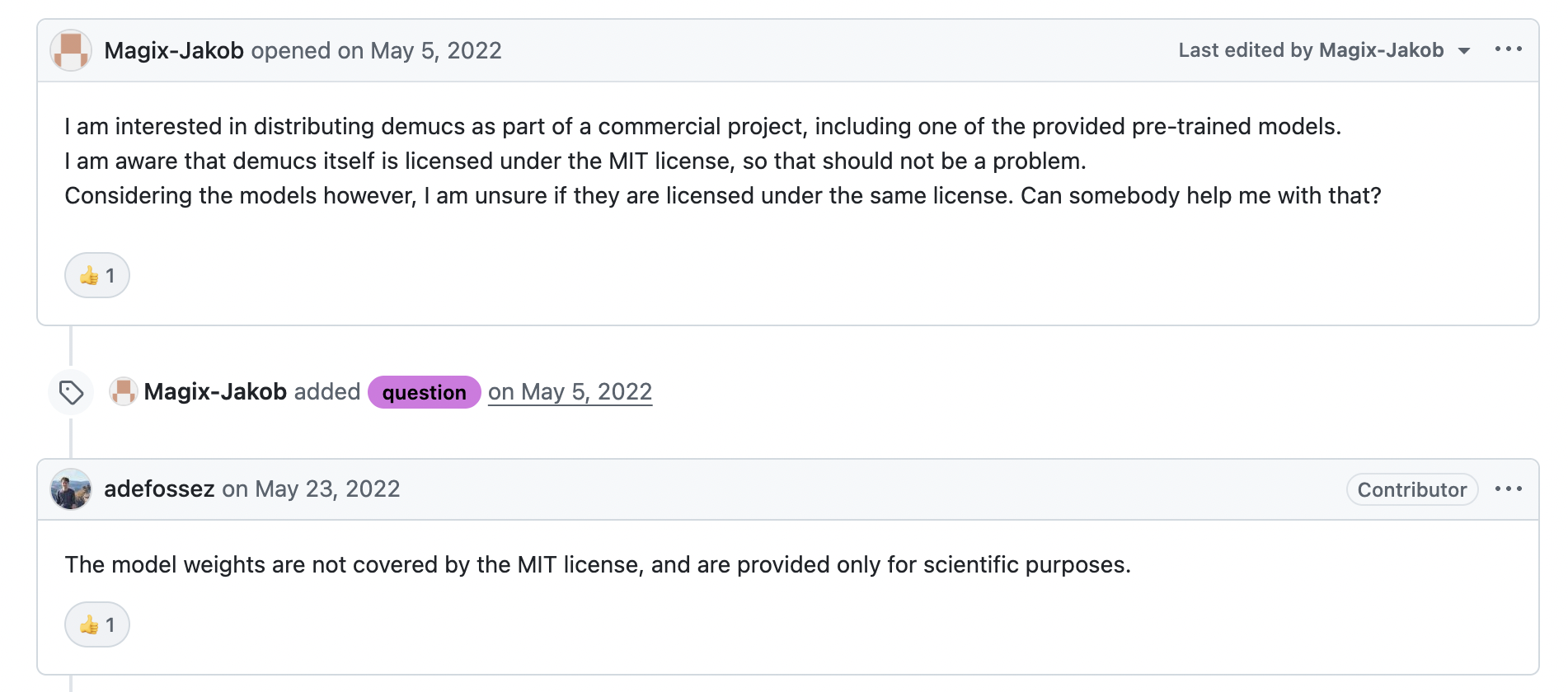
So you end up with a model whose code is permissively licensed, but whose pretrained weights were developed using data restricted to research purposes and are now widely used in commercial software. Whether and how dataset restrictions extend to trained weights remains a complex legal question. But in this case, the Demucs author himself has clarified that the pretrained weights are not covered by the MIT license and are provided only for scientific purposes:
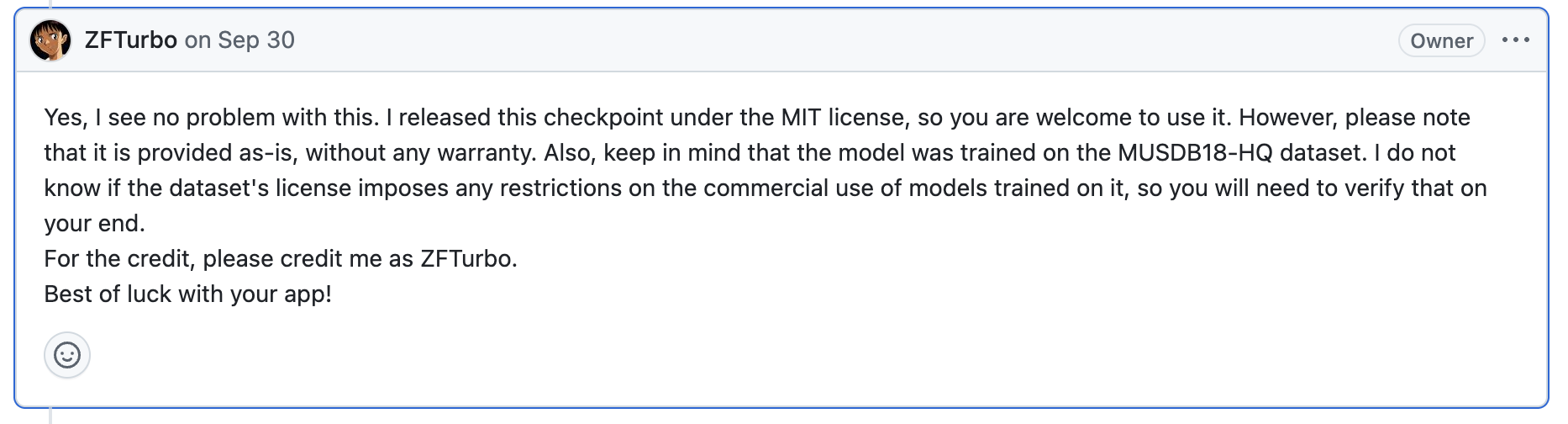
We see similar use of MUSDB18 with other popular open source models such as MVSep’s MDX23c and BS-RoFormer:
Why we’re writing this
We should be transparent about our interest here: AudioShake develops and sells commercial audio separation technology.
But long before AudioShake existed, we were academics. We helped build MUSDB18, and we care about what it was for. It pains us to see something built for academic research become part of a commercial ecosystem without clear answers about whether those uses are consistent with the terms under which artists contributed their recordings.
AudioShake started from the belief that technology that changes how music gets made should be built with the people who make it, not around them. That’s why we made our products available to labels, publishers, studios and artists first, and why we’ve invested significantly in licensing training data. We do not train on MUSDB18.
Further reading: For a side-by-side comparison of AudioShake and Demucs separation quality, including benchmark scores and audio examples, see our AudioShake vs. Demucs comparison.